
Town of Fishkill City Directory Collections
Fishkill does not have one continuous, modern municipal directory. Its historical directory trail is a set of book scans, local shelves, and newspaper files that cover different places and periods. Begin with the precise title and year when possible. The Town of Fishkill, the incorporated Village of Fishkill, Beacon, Glenham, and nearby Poughkeepsie can appear in different collections, and a nearby volume is not proof that an address lay in Fishkill.
| Collection | Years | Where Held | Access |
|---|---|---|---|
| Historical Sketch and Directory of the Town of Fishkill, T. Van Wyck Brinkerhoff | 1866 | FamilySearch, Blodgett, and DCHS shelf records | Digitized 149-page scan; read page images |
| Beacon Fishkill and Glenham Directory | 1924-25 | DCHS Books, Records and Libraries locator, F:127:D8 | Inspect the volume for entry layout and coverage |
| Fishkill Journal | 1860-1865 | Blodgett/Mid-Hudson collection | Hard copy or microfilm |
| Fishkill Weekly Times | 1882-1918 | Blodgett/Mid-Hudson collection | Local-history research access |
| Southern Dutchess News | 1983-present | Blodgett/Mid-Hudson collection | Archived local reporting |
The 1866 book and the 1924-25 combined volume establish real local points, not a complete sequence between them. No official collection description verifies a Fishkill reverse or criss-cross run. Ask the local-history desk about a particular title or year rather than assuming an address-ordered section exists.
Fishkill's 1866 Directory Scan
The earliest identified Town of Fishkill directory is T. Van Wyck Brinkerhoff's 1866 Historical Sketch and Directory of the Town of Fishkill, with an Appendix of Much Useful Information. It is a 149-page digitized book, not a record-by-record database. That distinction matters. Search results and catalog fields can identify the item, but the printed page is the authority for a person's initials, punctuation, abbreviations, and any address wording.
Open the digitized 1866 Brinkerhoff volume before transcribing an entry. The captured image below shows the source that supplies the scan.
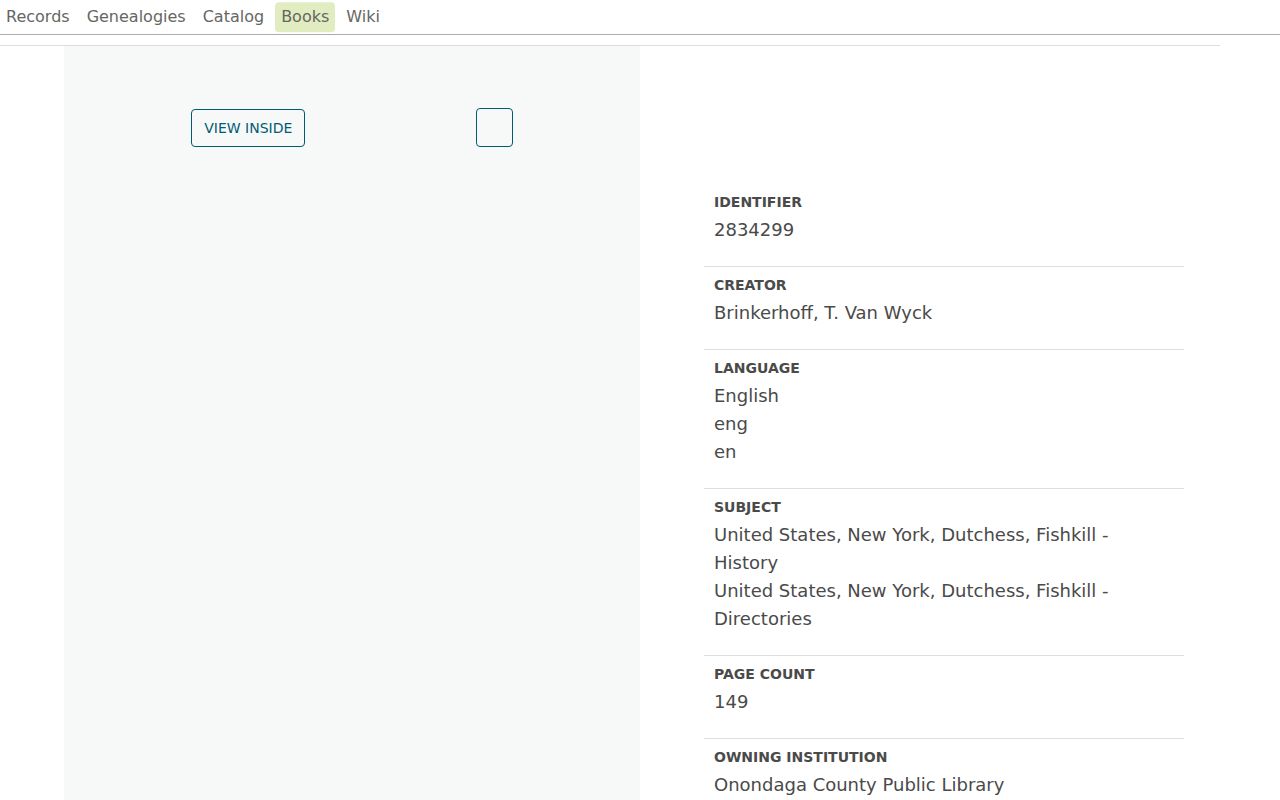
Keep the page number with every Fishkill city directory transcription. The volume can also supply local context before a name search, but it should never be treated as an OCR-perfect list or as proof of a present-day connection.
Fishkill's Blodgett History Desk
Blodgett Memorial Library's Local History Room is the practical local starting point when a scan is incomplete or a title is known only by date. Blodgett is at 37 Broad Street in Fishkill, and the collection page names Toni Houston as local-history librarian. Appointments are preferred. It holds directories, newspapers, manuscripts, photographs, clippings, historic postcards, and genealogy material that is not generally exposed through the online catalog.
The published local-history hours differ from the library's general-hours update, so confirm access for a particular request. A known title and year let staff pull a volume more readily; broader questions are better arranged in advance.
The Blodgett local-history collection also documents the available research contact and local materials.
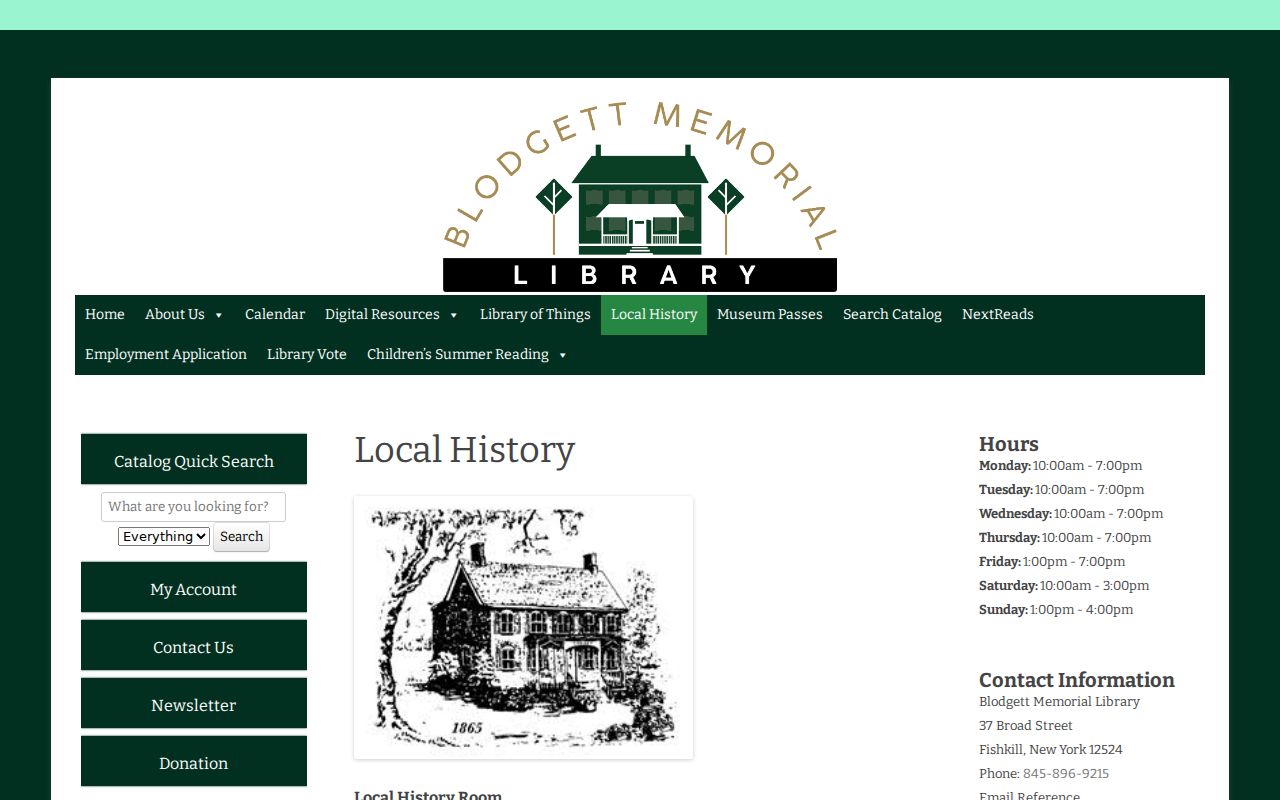
Its city directory, newspaper, and manuscript holdings help test a Fishkill directory appearance against a contemporaneous notice, obituary, legal item, or address reference.
Fishkill's DCHS Records Shelf
The Dutchess County Historical Society collections add finding aids, advertisements, biographies, programs, land deeds, ephemera, clippings, and typed transcripts to the Fishkill paper trail. The society moved its collections to 6282 Route 9 in Rhinebeck in 2023. Its Kelly Genealogical Library locator includes Dutchess County probate records from 1752 to 1865 and early Fishkill Landing Methodist Church records from 1862 to 1933.
The DCHS Yearbook subject index spans 1914 to 2019. Cornwell family deed and letter material is mostly Fishkill-related, while the Books, Records and Libraries locator identifies the 1924-25 Beacon/Fishkill/Glenham volume. Those tools can turn a spelling or address fragment into a request for a specific box, book, or subject.
The historical society's collections entry point is the source for these finding-aid leads.
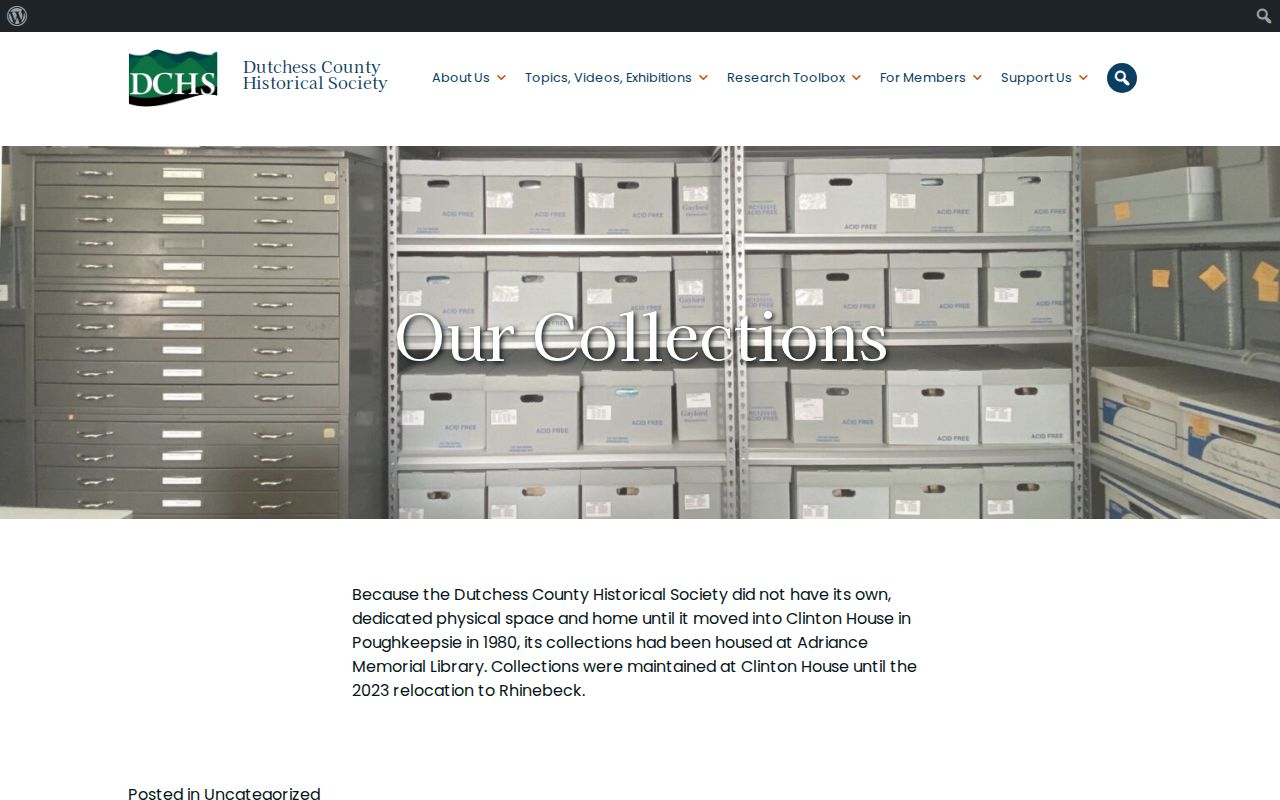
Use a locator result as a way to request or inspect Fishkill city directory material, not as evidence that a named person appears in every related collection.
Reading a Fishkill Directory Entry
A Fishkill city directory entry should be read as printed, one line at a time. The research did not retain a private person's entry, so no fixed field set can be promised for every page or volume. Record only what is visible, then preserve enough citation detail for another reader to locate the same scan.
| Name as printed | Copy initials, spelling, punctuation, and any alternate form exactly. |
|---|---|
| Relationship notation | Record it only if the entry itself prints a spouse or other connection. |
| Business notation | Keep a business or service description only when it appears in the scan. |
| Street or address | Preserve the number, street form, and abbreviation without modernizing it. |
| Source details | Capture directory year, creator, page, abbreviation key, and scan URL. |
- Criss-cross directory
- An address-ordered portion of some later directory volumes. No verified Fishkill run was located, so confirm a specific volume with the library before relying on one.
- Householder index
- A name-focused index that may identify the primary listed person. It is not necessarily a complete count of everyone connected to an address.
- Abbreviation key
- The explanatory list printed in a volume, often near its front matter. Read it before expanding shorthand in an entry.
Fishkill Directory Clues in Newspapers
Newspapers cover gaps that a directory leaves behind. Blodgett's documented runs include the Fishkill Journal from 1860 through 1865, the Fishkill Weekly Times from 1882 through 1918, and the Southern Dutchess News from 1983 onward. Legal notices, deaths, marriages, club notices, and business-address references can give a date or relationship to test against the book entry.
Long runs are not fully searchable online. The Mid-Hudson collection description identifies the holdings, while a request to Blodgett can lead to the original issue or microfilm when a search term fails. A newspaper item is supporting evidence, not a substitute for reading the directory scan.
Fishkill Directories and Census Years
Released federal census schedules give the household level that a printed directory may not show. Individual census records are public after 72 years. The public series currently reaches 1950, and the 1960 release is not due until 2032. Census boundaries and enumerator order can differ from the modern town and village lines, so retain the enumeration district and compare an address with nearby names rather than forcing a current boundary onto the older schedule.
Pairing sources works best in a fixed sequence:
- Copy the directory spelling, street form, page, and every abbreviation.
- Check the adjacent identified volume or newspaper period for a move, death, or coverage change.
- Match the nearest released census year and note the enumeration district.
- Use a deed or assessment parcel only for the ownership question.
- Use an obituary, probate record, church record, or cemetery lead to test family links.
A disappearance can mean a move, a death, an omitted listing, or a different publication boundary. Do not turn it into a conclusion until a second record supports it.
Fishkill Directory Names and Places
Historical searches need more than one place name. Try Fishkill, Fishkill-on-the-Hudson, Matteawan, and Glenham when a surname or street does not appear under the expected label. The Town and Village of Fishkill are distinct records jurisdictions, while Beacon/Fishkill/Glenham is the title of the 1924-25 combined volume. A Poughkeepsie directory can help trace a nearby move, but it is not interchangeable with a Fishkill address.
Initials, married or former names, punctuation, and spelling variants also matter. Keep a note of the exact source form before trying a normalized search. For a later name that needs an official cross-check, use the separate Town of Fishkill resident lookup trail rather than treating a historical directory as current evidence.
Dutchess Historic Records in Numbers
Dutchess County's 2024 report documents 20,000 Ancient Document pages indexed, 20,000 historic court-record pages digitized in Phase 10, a $22,500 State Archives grant for another 20,000 pages in Phase 11, and 17,704 manuscript pages digitized with collaborators. Those figures show active preservation, but the county also warns that scans are not yet word-searchable because of OCR limits.
That limit explains why a title, page number, name variant, and shelf reference remain valuable. Dutchess County's record history reaches back to 1715, while Fishkill's identified directory trail is much more discontinuous. Careful scan reading and a library request remain part of sound historical research.
Fishkill's older place history also explains the wide range of supporting material. The Town history places the area in the Rombout Patent, Revolutionary War supply activity, and later mill and industrial communities. Land, church, newspaper, and family sources can therefore carry different place labels even when they concern the same local area. Treat that history as context for a source, not as a substitute for a page citation or a demonstrated family connection.
A careful request can join the sources without blending them. Give the library or society the printed name, title, date, page, and the historical place form already found. Then compare the response with the original scan, the DCHS locator, and a released census or recorded document. That preserves the difference between a catalog lead, a historical narrative, and a verifiable entry.
Note: Verify local-history and collection access before travel because hours, appointments, and in-person arrangements can change.